A Shared Day Out When Everyone Wants Something Different
Plan a shared day out around a clear route, paired activities and a reunion point, so friends with different interests can enjoy the same outing together.
How do you plan a shared day out when one person wants to walk, another wants to browse and someone else needs a proper sit-down? Give the group a route with a few natural choices along it, rather than making one activity the centre of the day. A shared day out can feel connected without asking everyone to want the same thing.
Think of the outing as a sequence: travel together, choose how to spend a stretch of time, then regroup for the next part. This works especially well in places with a clear centre, such as a market town, a park beside a museum or a seafront with cafés and paths. People can follow their own interests while remaining close enough to share the day.
Plan a shared route
Start with a place that gives the group more than one way to spend time. A town centre with a covered market, independent shops and a public garden offers more choice than a destination where everyone must join the same activity. Check a local map before setting off and note the accessible entrances, toilets and places to sit that matter to your group.
Choose a straightforward route between meeting points. For instance, the group might meet outside a library, walk together to the market square, then split up nearby before regrouping at a café. Keep the route legible: a named square or building is easier to find than “somewhere by the shops”.
Ask about practical preferences as well as interests. Does anyone need step-free access, frequent rests or a quieter place to wait? Is someone bringing a dog? These details shape which places are suitable, and are easier to address before the group is standing at a closed gate or a steep path.
Match activities to energy
Offer a small set of distinct options rather than trying to satisfy every preference with a custom itinerary. One person might browse a bookshop, another might take a gentle loop through the garden, and someone else could settle at a café with a view of the square. The point is not to rank the choices; it is to let people spend the middle of the outing in a way that suits them.
Make solo time a genuine option, but do not assume everyone wants it. People can pair up by interest or energy, and anyone who prefers company can choose a companion. If the group includes children or anyone who should not be left on their own, agree who will stay with them before splitting up.
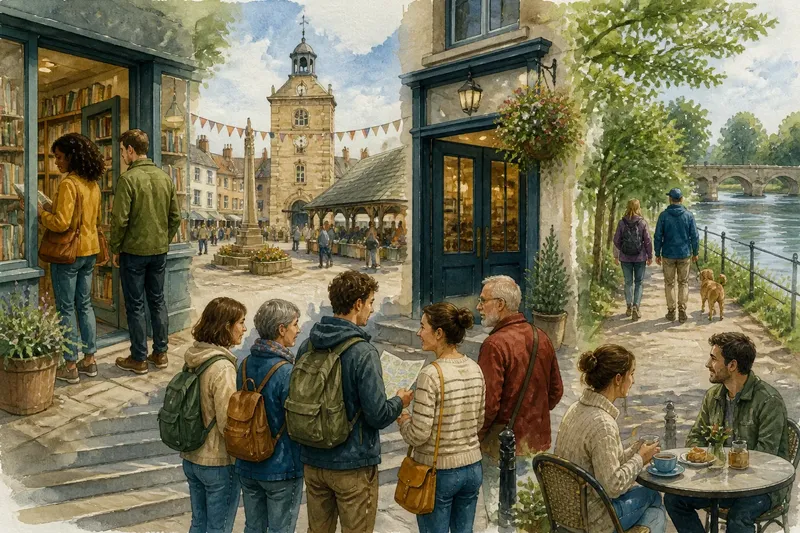
Say you are meeting in a fictional market town with a square, a small bookshop, a riverside path and a café. The group plans to meet at the library entrance, walk together to the square, then choose: one pair browses the bookshop, another follows the riverside path, and a third sits at the café. They set the café’s front door as the reunion point and plan to walk back to the library together. The result is a clear shared beginning and ending, while each person gets a middle stretch that suits them; the trade-off is that nobody gets to spend the whole time with every other person.
Make reunions clear
Set a specific place and time for meeting again. Use a visible landmark with a definite entrance, such as the café’s front door or the main gate to a garden. If there are several entrances, say which one. Share the plan in a group message so people can check it without relying on memory.
Agree what happens if someone is delayed or changes plans. A quick message can tell the group to wait inside, move to a nearby sheltered spot or continue to the next agreed point. If anyone may have limited phone access, choose a fallback meeting place as well.
Before you go, check the venue’s own information for opening arrangements, access and any restrictions that affect your group. Keep the route and options close enough together that a change of pace does not turn into a new journey across town.
How should the group decide?
What if no activity suits everyone?
Choose a route or meeting place that supports different activities, then agree on the parts you will share, such as the journey in and a final walk. If the place offers no useful choice, shorten the shared activity and leave more time for individual preferences.
How do we choose options nearby?
Look at a local map and choose activities within easy reach of the reunion point. If a route or venue seems hard to access, check its own information and pick a more suitable alternative.
What if someone changes their mind?
Keep the reunion point fixed and allow the activity to change. If the new choice would take someone beyond the agreed area, ask them to message the group and settle a safe, clear meeting arrangement first.
What if walking speeds differ?
Pick a route with places to pause, or let people choose between walking and resting during the separate stretch. If the shared route still feels uncomfortable for someone, shorten it or choose a more accessible way to travel together.
Keep choices workable
Use these checks before settling the plan. Each answer should lead to a clear decision, not another round of vague discussion.
- Observation: The group cannot agree on the same activity. If a nearby place offers distinct options, then use it as the shared base; otherwise, choose a brief shared walk or meal and plan separate activities afterwards.
- Observation: The proposed reunion point has several entrances. If one entrance is easy to identify, then name it precisely; otherwise, pick a different landmark with a clear front door or gate.
- Observation: Someone needs step-free access or regular rests. If the route and venues can accommodate that need, then include them; otherwise, choose an accessible alternative and check its details before travelling.
- Observation: The separate activities are spread far apart. If everyone can still reach the reunion point comfortably, then keep them; otherwise, replace one or more with closer options.
- Observation: A participant may not have reliable phone access. If they can use the agreed meeting point without a message, then keep the plan simple; otherwise, set a fallback place and make sure they know it in advance.
- Observation: The weather may disrupt an outdoor option. If there is a nearby covered place, then name it as the alternative; otherwise, choose an indoor activity before leaving home.
- Observation: A child or another group member needs supervision. If a named adult can stay with them, then agree who before splitting up; otherwise, keep the group together and choose an activity everyone can attend.
Leave minor decisions open. The group need not settle how long to browse or whether to stop for tea before leaving home. It does need to know which parts are shared, where the options are and how everyone will reconnect. If a bus departure or booked entry affects the plan, make that fixed point plain and leave some breathing room around it.
Share the last stretch
Regroup for one easy final activity: walk towards the station, sit in the garden or stop for a drink. That gives everyone a chance to reconnect without turning the outing into a formal review. Someone may mention a shop they liked; someone else may simply be glad to have rested.
A shared day out with different interests works best when the logistics are clear and the choices are real. For a shared day out close to home, plan the route, agree on accessible options and name the reunion point. Then the group can spend less time negotiating and more time noticing the place together.